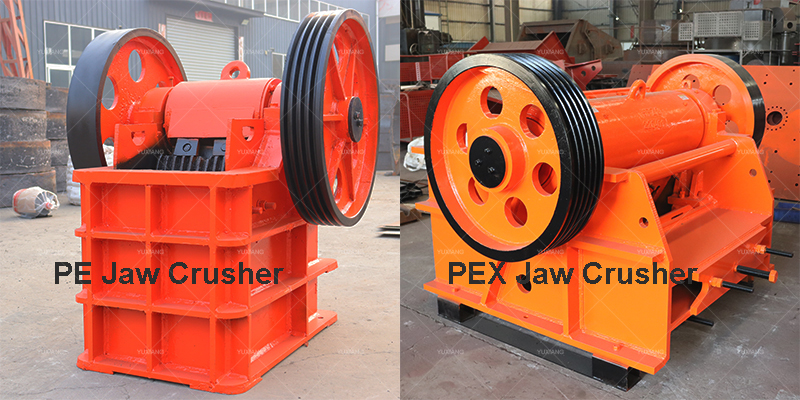
Before delving into complex technical specifications, it is highly beneficial to understand what these letters signify within the global mining equipment industry. Originally derived from manufacturing naming standards, these prefixes have since become common codes used to identify the primary functions of equipment.
The PE series jaw crusher (primary crusher) serves as a primary, coarse-crushing unit—the “heavy-duty workhorse” of the entire production process. Acting as the “vanguard,” it performs the initial stage of crushing on large, raw rock fragments sourced from blasting operations or mining sites. Renowned for its stable performance, high crushing ratio, and low operating costs, this equipment is widely utilized in various applications, including aggregate crushing, sand production, and other related operations. As a primary-stage jaw crusher, the PE series includes common models such as the PE200×300, PE200×350, PE250×400, PE400×600, PE500×750, PE600×900, and PE750×1060, with a maximum processing capacity of up to 1,200 tons per hour.
PEX Series Jaw Crusher (Fine-Crushing Jaw Crusher): The “PEX” series is designed for secondary or fine-crushing applications. Rather than handling massive rocks, these units process material—typically fist-sized—that has already undergone primary crushing by a PE series jaw crusher. They further reduce this material into smaller, more uniformly sized products, such as fine crushed stone or aggregates. Due to their relatively affordable price point, many users opt for these machines as an alternative to impact crushers or cone crushers. Common models in the PEX series include the PEX150×750, PEX250×750, PEX250×1000, PEX250×1200, and PEX300×1300. Their processing capacity ranges from approximately 8 to 100 tons per hour.