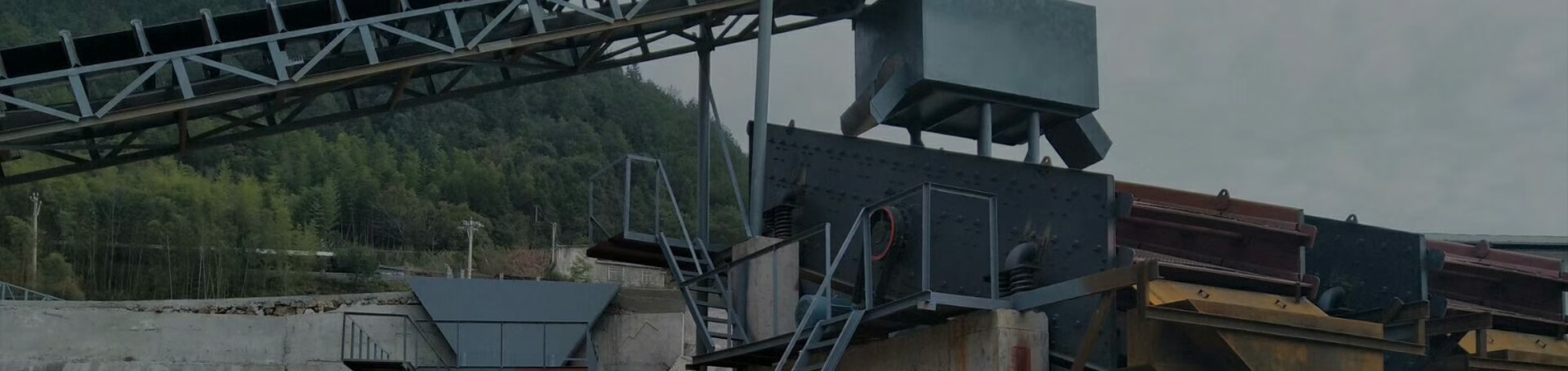
The ball mill is a key piece of equipment used for the fine grinding of materials after they have undergone initial crushing.
It is one of the most widely used machines for fine grinding in industrial production and comes in various types, such as tube mills, rod mills, cement ball mills, ultrafine lamination mills, horizontal ball mills, energy-saving ball mills, overflow-type ball mills, ceramic ball mills, and grate-discharge ball mills.
Ball mills are suitable for grinding various ores and other materials and are widely used in industries such as mineral processing, construction materials, and chemicals. They can be categorized into dry and wet grinding methods. Based on the discharge method, they are classified as either grate-discharge or overflow types. Based on the shape of the grinding cylinder, they are categorized into four types: short-cylinder ball mills, long-cylinder ball mills, tube mills, and conical mills.
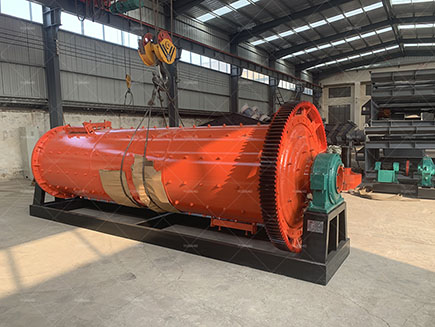
A ball mill consists of components such as a horizontal cylindrical shell, hollow inlet and outlet shafts, and mill heads. The shell is a long cylinder made of steel plate and fitted with internal steel liners. It is charged with grinding media—typically steel balls of varying diameters in specific proportions, though steel rods or slugs may also be used depending on the particle size of the material to be ground. Material enters the shell through the hollow inlet shaft. As the shell rotates, the grinding media are carried upward along the liners by a combination of inertia, centrifugal force, and friction; upon reaching a certain height, they fall back down under the influence of gravity, shattering the material inside the mill like projectiles.
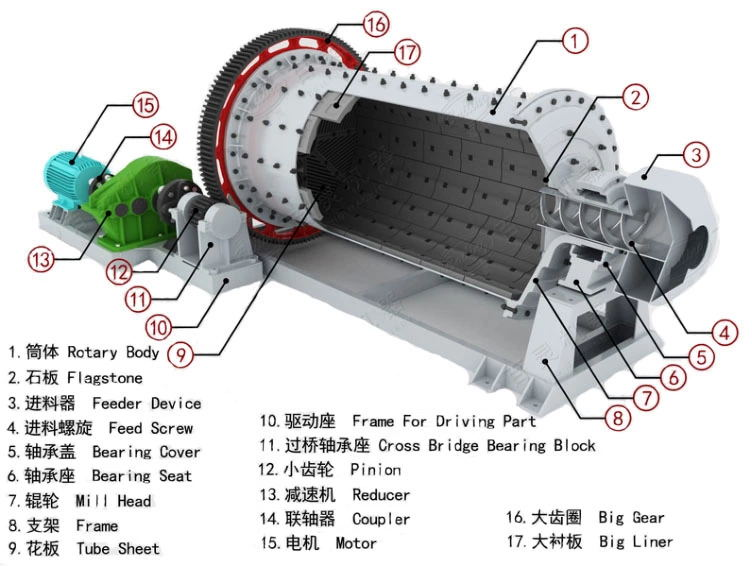
Material is fed uniformly into the first compartment of the mill via the feed device and the hollow inlet shaft’s screw mechanism. This compartment is lined with stepped or corrugated liners and charged with steel balls of various sizes; the rotation of the mill shell generates centrifugal force, lifting the steel balls to a certain height before they fall, thereby subjecting the material to heavy impact and grinding. After undergoing coarse grinding in the first compartment, the material passes through a single-layer partition plate into the second compartment. This section is lined with flat liners and contains steel balls to further grind the material. The pulverized product is discharged through the discharge grate plate, completing the grinding process.
As the mill shell rotates, the grinding media slide and fall, exerting a grinding action on the material. To optimize this grinding effect—particularly when processing coarser feed (e.g., around 20-mesh)—the shell is divided into two sections by a partition plate, creating a dual-compartment mill. In the first compartment, steel balls shatter the material, while in the second, steel grinding segments perform finer grinding. Material ground to the required fineness is discharged through the hollow outlet shaft. Conversely, when grinding finer feedstocks—such as sand, slag, or coarse fly ash—the mill shell may be configured without a partition plate as a single-compartment mill, utilizing steel grinding segments as the grinding media.
Raw material is fed through a hollow trunnion into a hollow cylindrical shell for grinding; the shell contains grinding media of various diameters (such as steel balls, steel rods, or pebbles). As the shell rotates around its horizontal axis at a specific speed, the grinding media and raw material inside are lifted by centrifugal force and friction. Once the force of gravity exceeds the centrifugal force, the media and material detach from the inner shell wall, falling or rolling down and shattering the ore through impact. Simultaneously, the sliding motion between the grinding media exerts a grinding action on the material. The ground material is subsequently discharged through the hollow trunnion.