Limestone is one of the most versatile raw materials in the industrial sector, serving as a cornerstone for cement production, construction aggregates, flue-gas desulfurization (FGD), and the manufacture of high-value-added fillers for the plastics and paper industries. To unlock its full potential, limestone must be ground into fine or ultra-fine powder; among the various types of grinding equipment available, the ball mill remains the most reliable and widely used solution for this task. Compared to other grinding machinery, limestone ball mills excel in processing hard materials, ensuring consistent particle size distribution, and maintaining continuous operation within demanding industrial environments. This article provides an in-depth analysis of how limestone ball mills function—with a particular focus on high-efficiency closed-circuit systems—outlines their core advantages and practical applications, and offers guidance on equipment selection. Whether you operate in cement manufacturing, environmental protection, or mineral processing, a thorough understanding of limestone ball mills will help you enhance production efficiency and reduce operational costs.
What is a limestone ball mill?
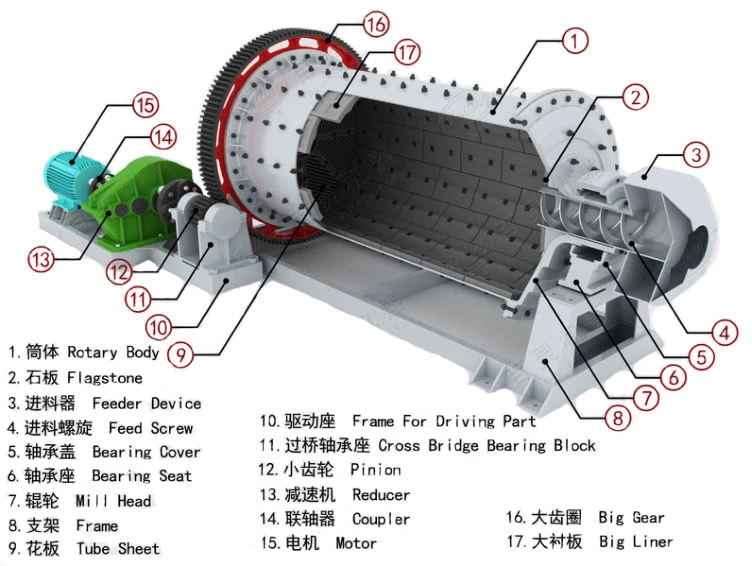
A limestone ball mill is a heavy-duty grinding machine designed to process crushed limestone into fine powder through the combined action of impact and friction. Its core components include a rotating cylindrical shell—lined with wear-resistant materials such as alumina ceramics to minimize material contamination—along with steel balls or rods that serve as grinding media, a drive system to rotate the shell, and mechanisms for material intake and discharge. Unlike Raymond mills or vertical roller mills, ball mills are renowned for their robustness and durability; they are capable of continuous, 24/7 operation in quarries, cement plants, and mines with minimal risk of frequent breakdowns. Their design is straightforward, requiring relatively little maintenance, while offering exceptional versatility—they can handle a wide range of feed particle sizes and produce powders of varying fineness, from 80 mesh up to 1250 mesh (ultra-fine powder). Modern models feature advanced sealing systems and operate under negative pressure, which effectively reduces dust and noise, making them more environmentally friendly than older equipment. Whether used as a standalone unit or as part of a closed-circuit system, the limestone ball mill is a vital piece of equipment for achieving efficient powder production.
How does a limestone ball mill work?
1. Basic Operating Principle
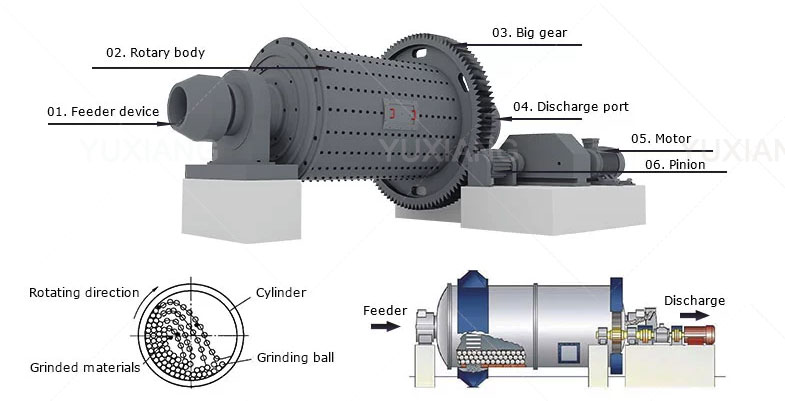
The operating principle of a limestone ball mill is both simple and effective. As the cylindrical shell rotates—driven by a motor and gear system—the steel balls inside are lifted to a certain height by centrifugal force before falling back down, striking the limestone material. This repeated impact, combined with the friction between the steel balls and the mill’s lining, crushes and grinds the limestone into finer particles. The rotational speed of the shell is precisely calibrated: if it is too slow, the steel balls cannot be lifted high enough to generate sufficient impact; if it is too fast, the balls will remain pinned against the inner wall of the shell, failing to fall. As the material is continuously ground, it moves toward the discharge end of the mill and is ultimately expelled in powder form. The fineness of the final product can be adjusted by varying the size and quantity of the steel balls, modifying the mill’s rotational speed, or altering the residence time of the material within the shell. Refined over decades, this fundamental mechanism has established the ball mill as a reliable choice for the consistent grinding of limestone.
2. Closed-Circuit Process and Equipment Configuration
Although open-circuit grinding—where material passes through the mill only once—is simpler and less costly to implement initially, it often results in over-grinding, non-uniform particle size distribution, and higher energy consumption. Consequently, most industrial production processes employ a closed-circuit configuration, which incorporates classification equipment to separate fine particles from coarse ones, with the coarse particles then returned to the mill for further grinding.
In a closed-circuit limestone ball mill system, key equipment components work in synergy to optimize efficiency. First, the ball mill grinds limestone into a mixture of fine and coarse particles, which is then transported—via belt conveyor or slurry pump—to a classification unit. The two most common types of classification equipment are dynamic air classifiers (such as turbine or rotor-type classifiers) and hydrocyclones. Dynamic air classifiers utilize centrifugal force and airflow to separate particles: rotating blades intercept coarse particles (i.e., those exceeding the target particle size, such as a D97 of 10 μm) and return them to the ball mill for further grinding, while fine particles pass through the classifier into a collection system. In contrast, hydrocyclones operate based on fluid dynamics: slurry enters the unit tangentially, creating a high-speed vortex. Under the influence of this vortex, coarse particles are pushed toward the vessel walls and discharged from the bottom (to be returned to the ball mill for regrinding), while fine particles rise within the internal vortex and are discharged from the top.
To ensure stable system operation, the setup includes auxiliary equipment: a bucket elevator for transporting material between the mill and the classifier; a cyclone separator or baghouse dust collector for collecting the finished powder; and a PLC control system for regulating parameters such as the classifier’s rotational speed or the pressure within a hydrocyclone. This configuration reduces over-grinding by 30%–40%, lowers energy consumption by 25%–40%, and produces powder with a uniform particle size distribution—a critical requirement for applications such as flue-gas desulfurization (FGD) or the production of high-end fillers.